
 Request Appointment
 Forms
FormsDental Bridges Leesburg
Eliminate the Gap and Renew Your Smile
Are you among the millions of people who are missing at least one tooth? If so, we strongly encourage you to learn about your tooth replacement options. Here in our Leesburg office, our skilled team offers high-quality treatments that can eliminate gaps and renew your smile. One such option is dental bridges. What are bridges, and how might one benefit you? Continue reading below to find out, or get in touch with us to set up an appointment.
Why Choose All Smiles Leesburg for Dental Bridges?
- Lifelike Restorations Made of Zirconia or E-MAX
- Results that Last for Years
- Dental Insurance Welcomed and Maximized
What Is a Dental Bridge?

A dental bridge is a multi-unit dental prosthetic that is designed to replace missing teeth. It works by spanning gaps in the dental arches where teeth have been removed or lost. Usually, bridges replace 1 – 3 teeth in a row, though in some cases, they can be used for larger gaps. They can be made of various materials, but our office tends to favor lifelike options such as zirconia and E-MAX, both of which are types of ceramic; these are very durable and can be color-matched to blend in seamlessly with the surrounding dentition.
Types of Dental Bridges
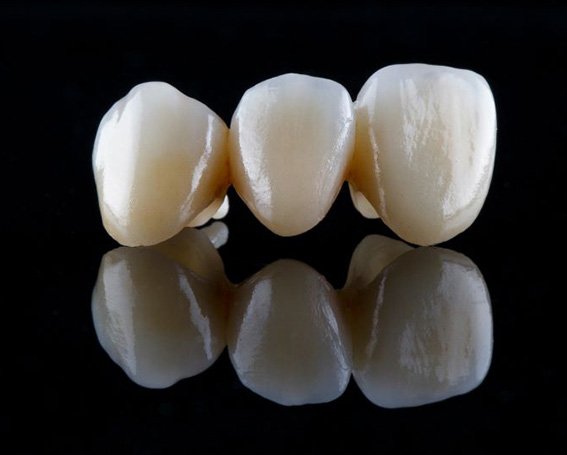
There are a few different types of dental bridges, each of which has its own advantages and disadvantages. During your consultation, our team will consider the details of your case and recommend the type of restoration that we believe is most suitable for your situation. Depending on what we discover, we might advise you to get either a traditional dental bridge or an implant bridge.
Traditional Dental Bridges
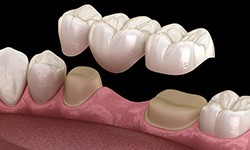
A traditional dental bridge may also be called a fixed bridge. It has a crown on each end, which we attach to the teeth that sit on each end of the gap in your smile (called the abutment teeth). This treatment process takes just a few appointments and can provide you with a reliable bite and beautiful smile for several years or longer.
Implant Bridges
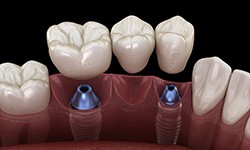
While a traditional dental bridge gets attached to natural teeth that need to be filed down in order to fit beneath crowns, an implant bridge is different. It is anchored in the jawbone via prosthetic tooth roots (dental implants). The implant posts get inserted into the jawbone at each end of the gap in your smile, and then a bridge is secured to their top. Implant bridges are incredibly strong and can help to keep the jawbone healthy and whole. They also do not require the modification of the abutment teeth.
The Benefits of Getting a Dental Bridge

Tooth loss can lead to some devastating consequences, especially if you do not pursue timely tooth replacement. For example, your remaining teeth might shift out of place; you could even be at an increased risk of further tooth loss. Your confidence, appearance, and ability to eat your favorite foods might take a turn for the worse.
A dental bridge can help with all of those issues. Not only does it serve as a steadying force that keeps your natural teeth where they belong, but it can also support oral function and provide pleasing aesthetics.
It is important to replace missing teeth! Visit our skilled team to learn more about your options.
Dental Bridges FAQs
Can you take a dental bridge out?
A dental bridge is designed to remain securely fixed in position for many years, so it should be impossible for you to remove your appliance without the help of a qualified dentist such as one of the skilled professionals at All Smiles Leesburg. Some healthcare providers refer to partial dentures as removable bridges, but this is a misnomer since traditional dentures are not anchored in place within the mouth. If you find you are able to remove your bridge on your own or that the appliance is loose, please contact the team at our dental office so we can repair or replace the device as necessary.
How many teeth can a dental bridge replace?
A dental bridge can replace between one and four sequential missing teeth. In most cases, traditional bridges are used to replace one or two teeth since devices longer than that can become unstable, which can make it easier for the crowns supporting the device to separate from the teeth wearing them. Implant bridges, on the other hand, can often replace up to four teeth since they are anchored directly to the patient’s jawbone. We’ll be happy to help you understand the best way to replace your lost teeth when we see you at our office in Leesburg for your consultation.
Can dental bridges be whitened?
Teeth whitening treatments are designed to lift stubborn stains from natural dental enamel, so they cannot affect dental bridges or other restorative appliances. Whitening your teeth after receiving a dental bridge can lead to your smile developing an uneven color, so it may be best to have your teeth whitened before receiving a bridge so the device can be shaded to match your smile’s bright new hue.
Can dental bridges develop cavities?
Dental bridges cannot develop cavities or other infections since they are not made from natural tissue. However, the natural teeth or gum tissue supporting a dental bridge can still be compromised by oral infection, which can make it necessary to remove the appliance so the issue can be treated. To prevent this, it will still be important to practice excellent oral hygiene even if all your teeth have been replaced with bridges or other prosthetic devices. Your hygiene regimen should include measures to clean around and under your bridge such as using floss threaders or water flossers. If your bridge is old, the cement holding it in place may develop cracks that bacteria can colonize, so your device may need to be repaired or replaced to prevent infections.